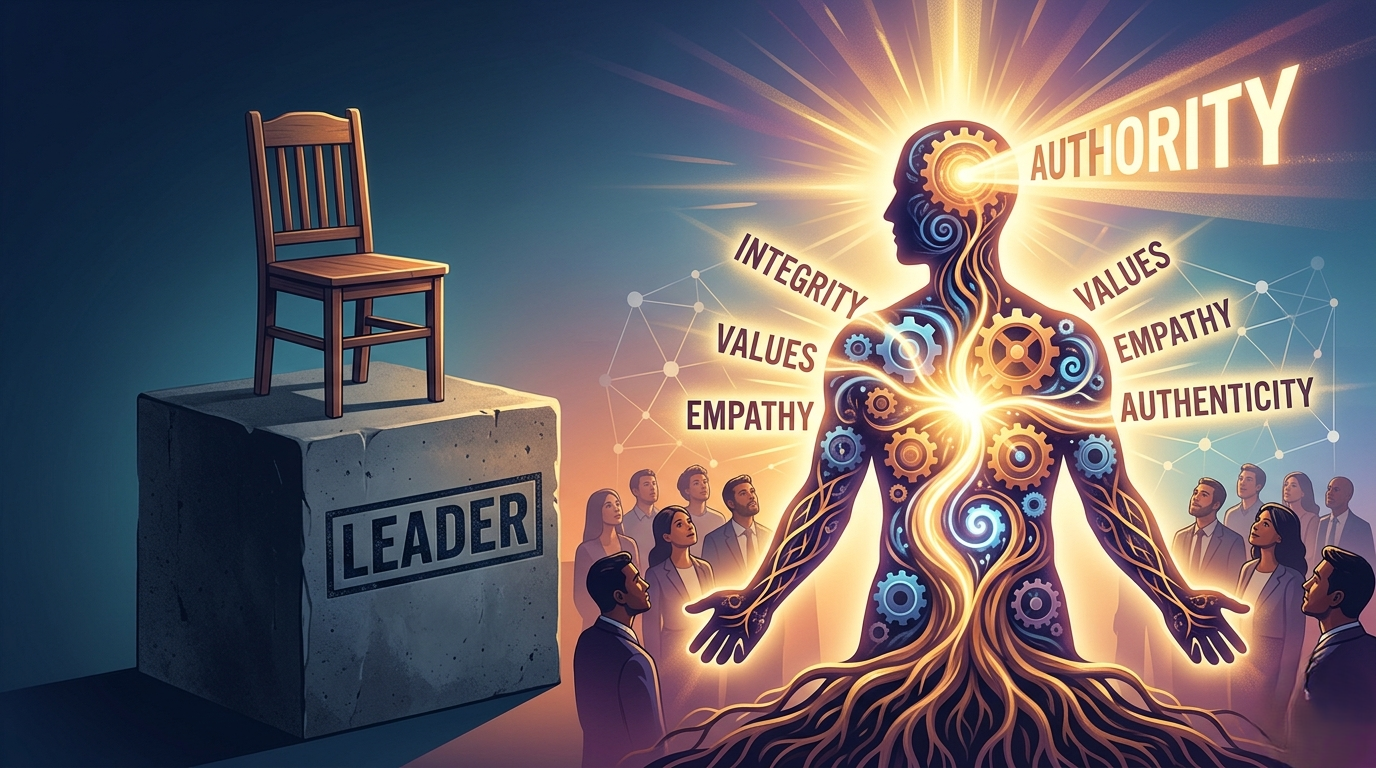
A title can be handed to you in a single afternoon. The authority that makes the title work cannot.
I have sat with capable leaders who received the promotion, the wider span of control, the corner office — and still felt like they were performing a role rather than living it. The title arrived. The authority did not follow it.
Identity-based leadership is the practice of building a leader from who they are before building what they do. It starts with truth in identity — a clear, honest understanding of the person beneath the position — and treats that understanding as the foundation every skill is later set on. It is the difference between a leader who simply holds a position and a leader the position can rely on.
I want to explain why this distinction matters, what it looks like in practice, and how you can begin building it before your next title ever arrives.
Why a Title Cannot Manufacture Authority
Organizations move quickly. A role opens, a competent person is named, and the quiet expectation is that authority will switch on with the new business card.
It rarely does.
A title gives you positional power — the right to assign work and make decisions. It does not give you the trust people extend willingly, the steadiness they read in a room, or the inner clarity that lets you lead under pressure without losing yourself. Those are not granted. They are built.
This is why two leaders with identical titles can feel so different to work for. One operates from a settled sense of who they are. The other is still auditioning for a part. People feel the difference long before they can name it — in how the leader handles a hard question, an unexpected setback, or a moment when the room is not on their side.
The Difference Between Identity and Performance
Most leadership development builds skills and behaviors. It teaches people to communicate more clearly, decide faster, manage conflict, hold a room. These are good things to learn. I teach many of them.
But skills sit on top of something. And if what they sit on was never built, the skills do not hold.
This is the wedge of my work, and I will state it plainly. Truth in identity is the only foundation that lasts. Everything built without it is performance.
Performance is leadership borrowed from the outside — from approval, from results, from the role itself. It can look impressive for a season. It cannot survive a hard one.
I think of a leader I worked with — a director, highly competent, fluent in every leadership technique she had ever been taught. On a good quarter she was excellent. But when a project failed publicly, the whole structure wobbled, because her authority had been built on outcomes. The day the outcome turned, she had nothing underneath it. Her skills were real. Her foundation was not.
Identity-based authority behaves differently. It does not depend on the room agreeing with you. It is who you are, made steady enough that pressure does not dismantle it. When the targets slip or the criticism lands, an identity-built leader bends without breaking, because the source of their confidence was never the result in the first place.
I build leaders who multiply leaders — and you cannot multiply what you have not first built in yourself.
What “Truth in Identity” Actually Means
Identity is not a personality label or a list of strengths from an assessment. It is deeper, and it is more practical than it sounds. In my work it sits inside the first pillar of the Radiant Multiplier Method — Clarity — and it comes down to four honest questions.
Who are you beneath the title? Strip away the role, the achievements, the things you are known for. What remains is the part of you that leads. Many high-achieving leaders have never paused long enough to meet that person. They have been the bank manager, the director, the founder — and somewhere along the way the title quietly became the identity.
Do you own your story? Every leader carries a history, including the parts they would rather not narrate — the setbacks, the failures, the seasons that did not go to plan. A leader who has made peace with their full story leads from a settled place. A leader still hiding part of it leads from a guarded one, and people can feel the guarding.
What drives you? Intrinsic motivation is not the same for any two people. The Reiss Motivation Profile, which I am certified to administer, identifies the deep desires that genuinely move a person — and they are often not the ones we assume. Leaders who understand their real drivers stop forcing themselves into a borrowed definition of success. They lead in a way that does not run them empty.
What do you believe — and is it true? Every leader operates from a set of beliefs about themselves, about people, about what they are allowed to be. Some of those beliefs are accurate. Some were absorbed long ago and have never been examined. The work of CBT and REBT — also part of my practice — is to bring those beliefs into the light and test them, because a leader’s beliefs quietly shape every decision they make.
These four questions are not soft. They are the most strategic work a leader can do, because everything else is built on the answers.
I will be honest about one more layer, because it sits at the center of how I see this. I believe identity is ultimately received, not constructed. We do not manufacture our worth through performance; we are given it. For me that conviction is gospel-rooted, and it changes how a leader carries pressure — because when your identity is settled by something larger than your results, a difficult quarter can no longer tell you who you are.
What I Had to Learn the Hard Way
I did not learn any of this from a book. I learned it by living the other way first.
I grew up without much stability, and like many people who grow up that way, I drew an early conclusion and made it a private rule: I would never be weak, and I would never depend on anyone. That rule became the engine of my life. I worked young, earned my own money, took on leadership roles, and built a version of myself that looked confident and entirely self-sufficient. For a long time it worked — at least from the outside.
What I could not see was that the whole structure rested on performance. My competence was real, but my identity had quietly fused with it. So, when the hard seasons came, and they did come, there was very little underneath to hold me. I had built a self that depended on always being strong, and a self like that has nowhere to stand when strength runs out.
The turning point was not a leadership course. It was coming to faith in 2011, and then slowly, over years, learning to stop performing and let my identity be settled by something I did not have to earn. That is when leadership stopped being a role I maintained and became something I could carry. I teach identity before title now because I spent too many years proving the cost of the alternative.
If you want to see how this journey unfolded beyond words on a page, my life story and marriage restoration were featured in CBN Asia’s The 700 Club Asia and dramatized in the Holy Week special Tanikala: Paghilom on GMA watch the feature announcement. You can also watch my reflection on being featured by CNN Philippines and Creamsilk as one of their most inspiring motivational speakers and image consultants.
Why This Matters More Now
Leadership has become harder to perform your way through.
The 2026 leadership outlook from DDI describes a working environment shaped by artificial intelligence, sustained uncertainty, and human expectations rising faster than most organizations can adjust to. Leaders are being asked to hold ambiguity, decide with incomplete information, and stay steady for teams who are themselves unsettled.
You cannot do that from performance. Performance needs stable conditions to look good. Identity does not.
There is also a measurable cost to the gap. Great Place to Work research across Asia found that at the region’s best workplaces, 91 percent of leaders have a clear view of where the organization is going and how to lead it there — against 66 percent at typical workplaces. Clarity is not a personality trait some leaders are born with. It is built. And it shows up in results.
How to Begin Building Identity Before the Next Title
You do not need a program to start. You need honesty and a little time.
Separate who you are from what you do. For one week, notice how often you describe yourself by your role or your output. The habit reveals how much of your identity has quietly merged with your performance.
Examine one belief you lead from. Choose a belief you hold about yourself as a leader — “I have to have every answer,” “I cannot show uncertainty,” “my value depends on the result.” Ask one question of it: is this true? Most limiting beliefs do not survive that question.
Name your real drivers. Look honestly at what genuinely moves you, not what you think should. Leaders who know their true motivation make decisions that hold, because the decisions are finally their own.
Find a source of confidence the next hard season cannot touch. If your confidence is built on results, results will eventually shake it. Build it on something steadier — your character, your values, your faith, the part of you that does not move when the numbers do.
This is slow work. It is also the work that makes every later skill hold.
The Real Test of a Leader
I do not want to be the brightest candle in the room. I want to leave a room full of light that does not need me to keep burning.
That is only possible for a leader built on identity. A leader running on performance cannot multiply themselves, because there is no stable self to pass on — only a role being maintained. A leader built on identity can develop other leaders, because they finally have something real to give.
The title will come, or it has already arrived. Build the person underneath it. That is where authority lives.
Frequently Asked Questions
What is identity-based leadership?
Identity-based leadership is an approach that builds a leader from who they are before building what they do. It treats truth in identity — a clear, honest understanding of the person beneath the role — as the foundation that skills and behaviors are later set on, so they hold under pressure.
How is identity-based leadership different from skills training?
Skills training builds behaviors such as communication, decision-making, and conflict management. Identity-based leadership builds the foundation underneath those behaviors first. Skills training alone tends to fade once a program ends; skills built on a clear identity last.
Can identity-based leadership be taught?
Yes. Identity work uses structured tools — the Reiss Motivation Profile for intrinsic motivation, CBT and REBT methods for examining belief systems, and guided reflection on story and self-understanding. It is rigorous, practical work, not a personality exercise.
Why does identity matter for executive presence?
Executive presence is identity made visible. When a leader is clear about who they are, that clarity shows in how they carry themselves, speak, and hold a room. Presence built on identity reads as genuine; presence performed without it reads as effort.
Closing — Call to Action
If your leaders hold the titles but not yet the steadiness underneath them, that is the work I do. I speak and develop leaders around identity-based leadership, executive presence, and the discipline of leading from wholeness rather than exhaustion.
If you are planning a leadership event or a development program for your organization, I would value the conversation. Book Toni for a keynote or start a conversation about your team.
About the Author
Toni Miranda is a leadership development speaker, executive coach, and Certified Image Consultant. She is the founder and president of Radiance Image Consultancy and Training Inc., and since 2017 has developed leaders across banking, government, insurance, and multinational organizations — among them the Development Bank of the Philippines, AMLC, Office of The President, LANDBANK, PLDT Smart, and Manila Water. Her work has reached more than 50,000 participants across 14 countries.
Her story has also been featured on platforms such as CBN Asia’s The 700 Club Asia, the Holy Week special Tanikala: Paghilom, and CNN Philippines, alongside her speaker profile on Olern (view profile)
She also writes from lived experience. Her own story includes a long season of leading from self-sufficiency and a carefully managed image, a financial crisis that took years to recover from, and a slow restoration that reset how she understands identity, motivation, and leadership. She is currently in her third semester of a Master of Ministry, and her leadership work stays gospel-rooted while remaining credible across corporate, government, and mixed audiences.
For speaking engagements and leadership development programs: www.toni.ph · bookings@toni.ph